More than one payer
Primary and secondary coverage, policy holders and claim numbers are stored on the case, not buried in notes.
PIP & auto accident billing
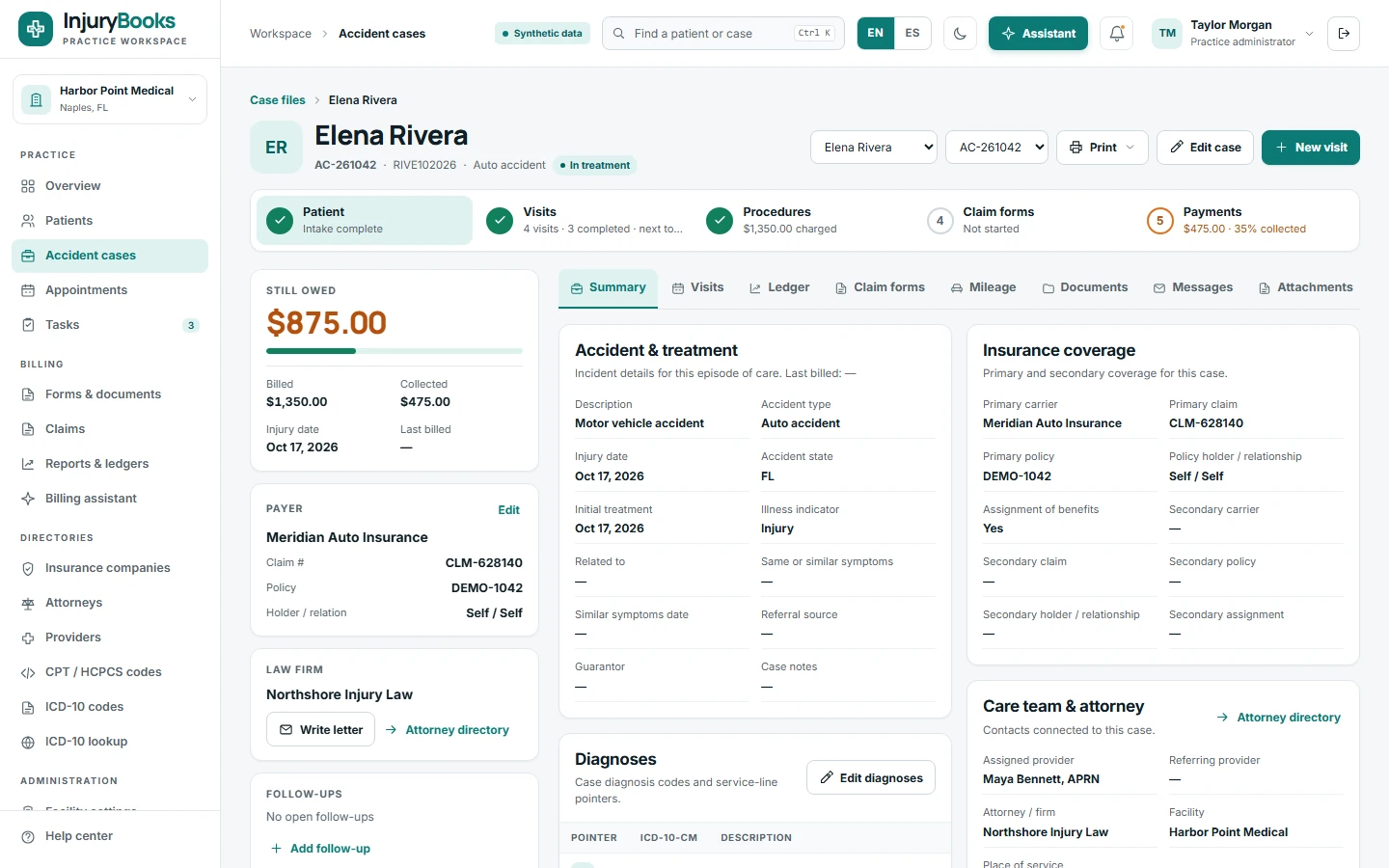
Personal Injury Protection claims follow the accident, not the visit. Injury Books keeps the auto insurer, claim number, adjuster, attorney, visits, charges and payments for each accident in one case file, so nothing slips between payers.
Why PIP billing is different
In a no-fault auto claim, the patient's own auto policy pays first, other coverage may follow, and an attorney is often involved. Tracking that in a system designed for routine office visits means spreadsheets and sticky notes.
Primary and secondary coverage, policy holders and claim numbers are stored on the case, not buried in notes.
Link the law firm to the case, write letters, print labels and report patients by attorney.
Partial payments are normal. The case shows billed, collected and still owed, and follow-ups remind you to chase the rest.
How it works
Open the accident case. Injury date, accident type, the state where it happened and how treatment began.
Add the auto insurer. Policy, claim number, adjuster, policy holder and assignment of benefits.
Link the attorney. The law firm stays on the case for letters, labels and reports.
Record visits and charges. CPT codes, units, modifiers and diagnosis pointers for each visit.
Generate the CMS-1500. Print or download the PDF; the draft is saved to the case.
Post payments and follow up. The balance updates and the action queue shows what to chase next.
PIP billing questions
Personal Injury Protection (PIP) is the part of an auto insurance policy that pays medical costs after a crash, regardless of who caused it, in states with no-fault rules. PIP billing means sending the treating clinic's charges to that auto insurer under the patient's claim number, then tracking payments and any remaining balance.
Injury Books generates the CMS-1500 (also called the HCFA) used by doctors, chiropractors and therapists, as a print-ready PDF saved to the case. Electronic clearinghouse submission is not available yet.
Yes. Each accident is its own case with its own insurer, claim number, attorney, visits, charges and balance.
Yes. Each case stores primary and secondary carriers with their policy, claim number, policy holder and assignment of benefits.
Tell us about your clinic and we will show you Injury Books and send pricing.